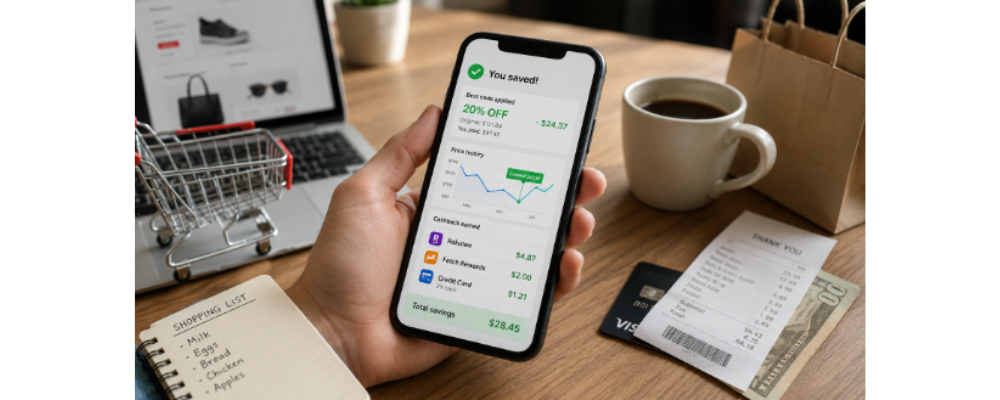
How Your Phone Saves You Money While You Shop
Most people carry a phone loaded with streaming services, food delivery shortcuts, and social media feeds, but almost none of the apps that give money back. You probably grabbed the 1xbet apk on your phone quicker than you ever installed a receipt scanner or a bill tracker. And that says more about app marketing than it does about you. Saving tools tend to have terrible ads and forgettable names, so they sit undiscovered on page three of every app store.
Five types of mobile apps deserve your attention in 2026, and they earn their keep by doing things you forgot to do, refused to do, or never knew were possible. .
Receipt Scanners That Pay for Your Grocery Runs
Thirteen million monthly active users chose Fetch for one reason: zero friction. Snap a photo of a receipt from a gas station, a pharmacy, a hardware store, literally anywhere. Points land in your account and convert to gift cards. No brand restrictions, no pre-activation, no coupon clipping.
Ibotta takes a different route. Offers tied to specific products need activation before you shop, and the payout per item runs higher. Households whose grocery lists align with Ibotta’s rotating deals pull $20 to $50 a month. Households whose lists don’t match pull close to nothing. That gap makes Ibotta polarizing, but paired with Fetch on a single receipt, two apps stop competing and start compounding.
| App | Per Receipt | Store Restrictions | Setup Effort |
| Fetch | 25 to 100 points (≈$0.03 to $0.10) | None | Photo only |
| Ibotta | $0.10 to $5.00 per item | Offer-dependent | Pre-activate |
| CoinOut | Flat micro-reward | None | Photo only |
A three-app stack on every grocery receipt adds $30 to $50 a month for an average household spending $600 on groceries, according to WalletGrower’s 60-day test in early 2026.
Automatic Savings Apps Worth Keeping
Your spare change already disappears on things you won’t remember by Tuesday. Round-up apps redirect it somewhere useful instead. Chime rounds each debit card purchase to the nearest dollar and moves the difference into a separate savings account. Dave goes further by offering a Goals account paying 4.00% APY with no minimums.
Tilt (formerly Empower) watches your income and expenses, then moves money into savings during windows where your balance can absorb it. Automation adjusts around payday and large bills, which prevents overdraft triggers that made older round-up tools unbearable.
A $0.47 round-up on coffee sounds laughable. But 30 coffees, 12 gas fill-ups, and 40 random purchases per month stack those fractions into $40 to $80 you never had to think about setting aside.
Subscription Trackers That Find Money You Forgot
Forgotten subscriptions bleed more from monthly budgets than most people suspect. Rocket Money scans connected bank transactions for recurring charges and lays them out in a single list, and users routinely discover $50 to $200 per month in services they stopped using. Cancellation happens inside the app.
Bill negotiation gets more complicated. Rocket Money contacts your cable, internet, or phone provider and bargains for a lower rate. Their success rate runs close to 90% on telecom bills. But they take 35% to 60% of your first year’s savings as a fee. If they shave $300 off your annual internet cost and you chose 40%, you hand over $120 upfront.
For people who would never pick up the phone and negotiate, that exchange works. For people willing to spend 15 minutes calling their provider, that discount often comes free.
When the Math Stops Working
- Premium subscription costs $7 to $14 a month, so annual spend sits between $84 and $168
- If your negotiated savings stay below $200 a year, the app barely breaks even
- Promotional rates from negotiation often expire after 6 to 24 months, resetting your bill to its original price
Cashback Apps That Reward Routine Purchases
Over 3,500 stores participate in Rakuten’s cashback program, paying you 1% to 10% back when you access retailers through their portal. Mobile users open the app, find the store, tap through, and shop as normal. Quarterly checks or PayPal deposits follow.
Dosh works on a different principle. Link a card once, spend at participating merchants, and cash appears in your Dosh wallet without scanning, clicking, or remembering anything. Fewer merchants participate, and percentage returns run lower, but the hands-off model appeals to people who refuse to add one more step to checkout.
Stacking a cashback credit card (1% to 3% on every purchase) underneath Rakuten or Dosh creates two earning layers on each transaction. A third layer comes from receipt scanners like Fetch, which accept receipts regardless of how you paid.
Setting Up Without Losing a Weekend
Five apps sounds like a commitment, but the install window fits inside a lunch break. Receipt scanners need a camera. Round-up tools need a linked bank account. Subscription trackers need a connected financial profile.
After setup, the only recurring effort is photographing in-store receipts, roughly eight seconds each. Every other function runs in the background.
One common trap: installing ten apps at once, burning out on notifications, and deleting everything by Friday. Start with one receipt scanner and one automatic savings tool. Add a subscription tracker after two weeks.